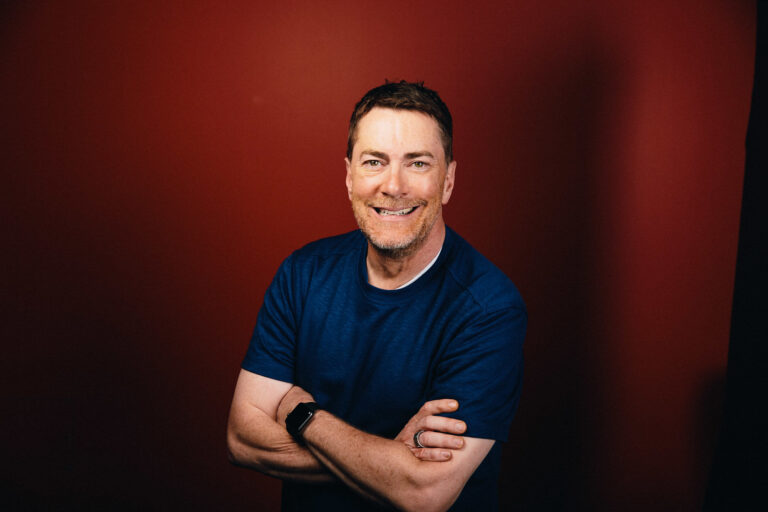
Greg Barman: From Dick Biondi’s Neighbor to Denver’s Newsrooms
He grew up down the street from a Chicago rock 'n' roll DJ and spent five years of vacations knocking on Denver station doors before one finally opened. Greg Barman remembers news shifts at KNUS, KCFR, KBCO and KOA, a Sunday-night UFO show sent out by satellite, and the generous people who let a curious kid sit in the engineer's booth.
Hear the whole interview
Jump to a part
Long before he read a newscast in Denver, Greg Barman was a kid in Evanston, Illinois, with a transistor radio under his pillow and a rock 'n' roll disc jockey living down the street. Getting to Colorado took him years. He worked a string of overnight shifts across the Midwest and the South, and he spent a lot of vacation days knocking on Denver station doors before one finally opened.
If you had KNUS, KCFR, KBCO or KOA on in the '80s and early '90s, there's a good chance you heard him on the news. His story keeps going after the newsroom, too. There's a UFO talk show beamed out by satellite, a low-power FM station built from scratch, and a lifelong soft spot for the people who helped him get his start.
Next door to Dick Biondi
Greg grew up in Evanston, in the Chicago area, back in the early '60s, when he was, as he puts it, "eight, nine, 10 years old or so." The neighbor who changed everything was Dick Biondi, who was "at his prime on WLS in Chicago in the early '60s," Greg says, "one of the big early powerful rock 'n' roll stations."
that's what sparked my early interest in radio, was having Dick Biondi as a neighbor.
Greg Barman
Every kid in the neighborhood knew it. Greg remembers "all the kids that knew where he lived and tried to knock on his door and find him and all that." At night he'd tune in. "I'd listen to him on my transistor radio under the pillow and all that," he says. He stayed in touch with Biondi for a while over the years.
Music ran in the family as well. "My family actually were all jazz music fans," Greg says. When he was about 12 or 13, his mom took him downtown to WAAF, a daytime-only jazz station the whole family listened to. It was the first radio station he ever saw from the inside, and there he "saw some of the giants of jazz deejaying at that time in Chicago." If you remember the first time you saw the people behind a voice you knew from home, you know how that kind of visit sticks with a kid.
The only jock without a Southern accent
Greg went to Indiana University in Bloomington, which he says had "a real kickass student radio station on carrier current heard only in the dorms." He majored in radio and television, but he also spent a lot of time at that station. "I majored in college radio, basically," he laughs. Some of the people he worked with there in the 1970s are still his friends.
Then they put me on morning drive 'cause I was the only disc jockey that didn't have a Southern accent
Greg Barman
After graduation he couldn't decide between deejaying and news, since he had journalism training too. "I figured I'll just take whatever job comes first," he says. That turned out to be an automated station near Norfolk, Virginia, WMYK. "That didn't last long. I didn't do too well." Next came WFLI in Chattanooga, Tennessee, a station owned by the same family, with 50,000 watts by day and 1,000 at night. He started on the all-night show. "Then they put me on morning drive 'cause I was the only disc jockey that didn't have a Southern accent," he says. He held that shift for about nine months.
Still, he says, "I felt like a fish out of water in Chattanooga at that time," and when a new program director came in, it was time to move on. He spent about three or four months at WKVQ, 15Q, in Knoxville. After a stretch back home in Chicago, he did all-nights at WMEE in Fort Wayne, Indiana. By then he'd reached a decision. "All right, I've had my fill as a disc jockey," he remembers thinking. "Why don't I try getting back in the news?"
He got a news job at KSO in Des Moines, the city where he was born, and after six months he moved up to WHO, "the 50,000-watt clear channel monster of Iowa." He stayed about a year and a half and calls it a "great job, great facility, wonderful people, good journalism." From then on he was a newsman. "Never looked back from there in terms of a news career," he says. The only drawback was the pay, because "radio news just didn't at that time." College friends then pulled him to WIRE in Indianapolis, a "country politan format connected to an all-state news network," where he spent about three years doing news.
Half camping, half knocking on doors
Greg first saw Colorado on a drive to California in the late 1970s. "I fell in love with Colorado," he says. "And a little bug got planted in the back of my head saying, 'You really need to live out here sometime.'"
I really wanted to get to Denver very badly.
Greg Barman
Through all his years in Des Moines and Indiana, he kept coming back on vacation, and he'd "spend half the time camping and half the time knocking on doors of radio stations." He tried KOA, KIMN and KHOW, plus a couple of other places. After five years of that, a startup talk station, KNUS, "took a risk on me."
The station didn't offer much help with the move. When the news director asked him to fly out for an interview, Greg asked if they'd cover the airfare. "They said, 'No, it's on your own dime.'" He flew out on a weekend anyway, went back to Indiana, and got the call: "You're hired." They wouldn't help with moving expenses either. "So I had to bite the bullet on that too," he says, "but I really wanted to get to Denver very badly." He packed his car, put some things in a moving van, loaded his Labrador retriever in the back seat and drove west. "The rest is almost history," he says. "But I'll tell you the history."
He wanted the whole Rocky Mountain life, the camping and skiing along with the radio. He spent about three and a half years doing news at KNUS, which he describes as "an up-and-coming news and talk station that was kinda nibbling away at KOA's audience." If you used to flip between the two on the dial back then, that was the race you were listening to.
Public radio mornings and KBCO weekends
When the oil bust hit, KNUS had layoffs, and Greg went into what he calls "a tailspin of other radio experiences." He worked part-time at KHOW and spent a few months on the TV assignment desk at Channel 7. Then, in the late 1980s, he landed at KCFR Public Radio and stayed about two years. He hosted the morning drive show and did a lot of freelance work for NPR. "I enjoyed working in public radio," he says. He left on his own and moved to KDZR, a small station that ran all business news.
So it was a lot of work, but it was all a lot of fun.
Greg Barman
By then he was asking whether radio still had room for him. News jobs were shrinking, he says, because of consolidation and the rise of TV news, and stations with big news departments "were either dumping them or reducing them to maybe just one or two people." So he found a new career in headhunting, helping companies find and hire engineers, "using a lot of the same skills I did as a newsman. You're calling people, you're doing quick research on folks and situations."
"But I wasn't ready to cut from radio yet," he says. He took a part-time news job at KBCO in Boulder and kept it for three years, anchoring weekend mornings and reporting during the week while he did his recruiting job. "So it was a lot of work, but it was all a lot of fun."
If KBCO was your station then, you'll remember how it was taking off. "KBCO was on the rise then at that time in Denver ratings with its album-oriented rock," Greg says, "and the staff was just tremendous to work with." He remembers a news staff of two full-timers and two part-timers, which seemed amazing to him for a rock station. Then cutbacks came, which he puts down to changes in the economy and an upcoming sale. "I was part-time, and I was cut."
A chance meeting at Soapy Smith's
After KBCO, Greg spent a few weeks looking for work. One day he walked into Soapy Smith's, a bar in downtown Denver, and ran into Jerry Bell. The two knew each other from news conferences around town. Bell was news director at KOA. "He said, 'Hey, Greg,'" Greg remembers, "'Have you found a job yet?' I said, 'No.' And he said, 'Well, we've got something part-time opening here.'"
Did the newscasts, you know, did the morning news show, go home and collapse.
Greg Barman
"One thing led to another," and Greg was on the street as a KOA reporter during the week and on weekends. Later he became anchor of the Saturday edition of Colorado's Morning News. That meant a lot of listeners, and very early mornings. He and a co-anchor came in at 1 a.m., did the overnight newscasts, wrote the morning drive news and then stayed on the air until 9. "Just wrote, wrote, wrote," he says. "Did the newscasts, you know, did the morning news show, go home and collapse."
He was also working a full-time job doing customer service for satellite TV subscribers at a company called NetLink. By the time he was getting into his 40s, it was too much. "Between trying to do a full-time job, you know, a part-time job, and trying to ski," he says, he was "burning the candle at both ends." He left KOA, and it turned out to be his last part-time radio job.
UFOs on Rush Limbaugh's satellite
Leaving KOA was "not quite the goodbye to radio," Greg says. He kept radio as a hobby, collecting airchecks and converting many of them to digital. Then came a stranger project. He teamed up with Michael Corbin, a man who "was really into this and had a wonderful voice," to produce a national talk show about UFOs and the paranormal. "I was always a bit fascinated with that stuff," Greg admits.
True confessions, I'm a jingle freak.
Greg Barman
They found an investor, pulled together a small staff and built a studio near 10th and Broadway. Through ABC Radio Satellite Services, the show "went up on the same satellite that Rush Limbaugh used to distribute his show." At its peak it was on about 20 stations, mostly in the West: KHOW in Denver, plus Salt Lake City, Monterey, Albuquerque and Rockford, Illinois. Around the same time, Art Bell was starting his own paranormal show out of Nevada. Greg says that show "was way better financed than we were," with much bigger connections. With no one on his team doing sales, there was no money coming in, and after about five years they ended the regular Sunday-night show. "Art Bell, of course, succeeded marvelously," Greg says. "But it was a lot of fun to do a syndicated show."
He got back behind the mic for real in Bloomington. IU alumni came up with a plan to borrow the student station, WIUX, for a weekend while the students were on break. In Greg's words: "let's all put on the headphones again, play retro rock." Every summer from 2007 through 2025 they went on the air, with special jingles made for the occasion through PAMS and later TM. "True confessions, I'm a jingle freak," Greg says. He collected jingles avidly in the '70s and '80s, and friends from Indiana who went to work in the jingle business in Dallas sent him "a flood of material."
Back in Denver, Greg read in Westword in 2013 that the FCC was opening a window for low-power FM licenses. "I thought, 'This might be fun.'" He joined a local group that was applying. That group later joined up with Denver Open Media, and together they won a license at 104.7, built the station and got it on the air. After interference problems it moved to 92.9. It struggled to raise money and listener support, and it now repeats KVCU, the CU student station in Boulder. Greg is proud they did it all themselves. "No consultants, no nothing. We just all DIY and managed to land the license and build the station."
The day you never saw coming
Of all the stories Greg covered, one stands above the rest: the shooting of KOA talk show host Alan Berg. "That was a big deal," he says. He was at KNUS at the time, where Berg's friend Peter Boyles worked, "and it was big national news." If you were in Denver then, you probably remember where you were when you heard.
You come into work, and you never know what's gonna happen that day.
Greg Barman
He also remembers "a lot of death and disaster stories," including the Continental Airlines crash sometime around the late 1980s or early 1990s. In 1995 he left news. "I was burning out a little bit, frankly," he says, "and I was ready to make a change." He could see news on radio declining. "And I got out before all the school shootings happened with Columbine, and I'm glad I got out before all that happened."
He still remembers what he liked about the job. "Radio news reporters don't get a chance always to specialize. You're general assignment. You cover everything. It's politics, it's business, it's cops, it's death and destruction." Because of that, he says, "you learn a lot about a town," and you get to deal with public officials up close. "You come into work, and you never know what's gonna happen that day."
These days Greg calls himself semi-retired. He still does HR consulting for technical companies, helping them hire electrical and mechanical engineers, and he's worked with places around Denver including the old Qwest and Arrow Electronics. He plans to keep a hand in that part-time, enjoy semi-retirement, "and keep my hand in radio wherever and however I can."
Coffee with Bob Dearborn
Greg looks back on his career with a lot of gratitude. "I was always impressed as I was getting in, in the early part of my career at how people I met were willing to be mentors and willing to help younger people," he says. As a kid he "made a pest of myself at Chicago radio stations," calling WLS, WCFL during their rock 'n' roll war, WMAQ and the new FMs to ask, "Hey, can I come up and see you?"
giving back to people who are interested in coming up is a very important thing.
Greg Barman
One of his idols was Bob Dearborn at WCFL in the early 1970s. Greg and a friend from the IU station called him, and Dearborn said, "Sure, let's have coffee." After coffee came another invitation: "Come visit my show later tonight." The Chicago stations were union shops, with separate jocks and engineers. "So we sat in the engineer booth and watched while the jock was in his studio, and watched them work back and forth and coordinate." Greg came away with a high-quality aircheck he still has. He calls Dearborn "a very kind guy, and one of the smoothest on-the-air people that I've ever heard in my life." Dearborn later worked in Pittsburgh, Tampa, Vancouver and Toronto.
Another mentor was Johnny Randolph, program director at WAKY in Louisville in the early and mid-1970s. The IU kids could hear WAKY on AM in Bloomington, about two hours away, so they called and asked to visit. "Johnny Randolph said, 'Sure,'" Greg remembers. They went down several times over a few years and had lunch with him. Greg learned later that Randolph had done the same for a young Louisville listener named Dan Mason, who "kept calling the request line" with ideas for the station. Randolph took him to lunch, and Mason went on to become president of CBS Radio.
Greg has tried to do the same for others. "I've tried to pay that back in whenever younger person I met that was interested in the radio business or interested in the recording business," he says. "In radio or any other profession, it's important to give back to people coming up, to try and lift them up."
More Legacy Interviews
Know a Colorado radio person whose story ought to be told? Tell us who, or if it’s you, share your own story.